Speed-to-Offer Playbook: Cut Fill Time 40%
Learn how async video, structured scorecards, and ready-to-sign offer templates can cut your time-to-fill by 40% in this step-by-step playbook.
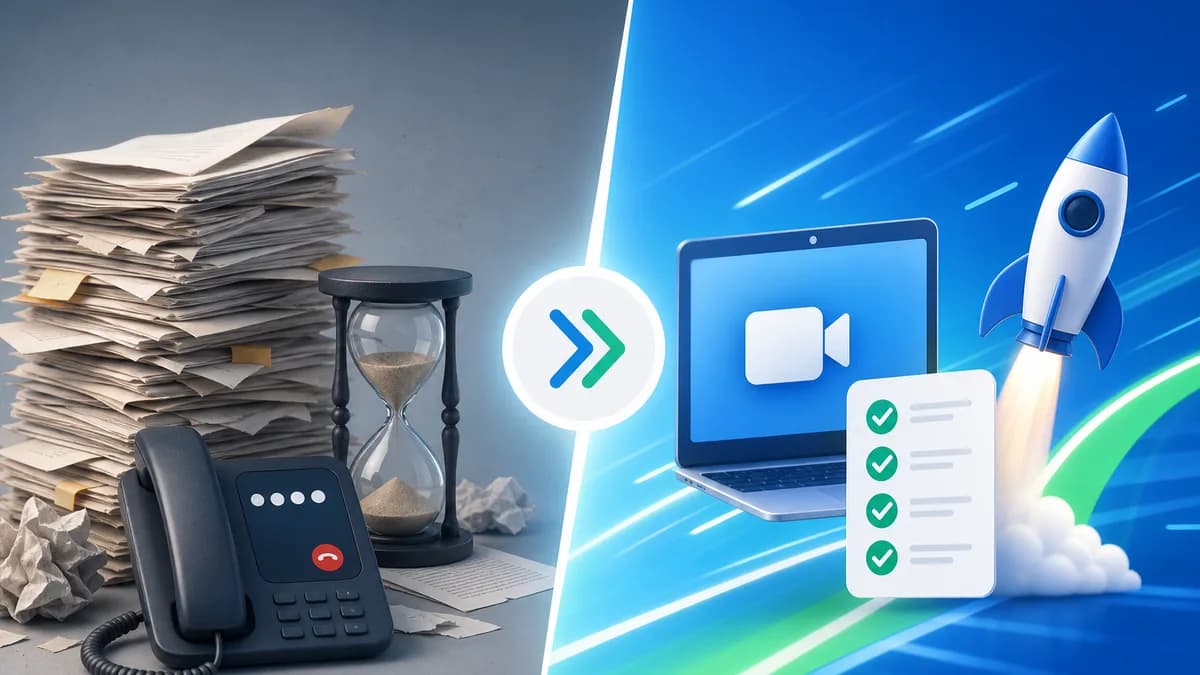
You Know That Feeling When a Great Candidate Slips Away?
The average time-to-fill hit 42 days in 2024, according to SHRM's Talent Acquisition Benchmarking Report. Every extra day you spin your wheels, that top-of-the-funnel rockstar is interviewing elsewhere, receiving counters, or losing momentum. I’ve lost candidates on day 38 of a search—38 days of work, gone. The root cause is almost never a lack of talent; it’s a process with too much friction between “yes” and the offer letter. This speed to offer playbook shows you how to stack three simple, high-impact changes—async video introductions, structured scorecards, and pre-approved offer templates—into a repeatable hiring sprint that can compress your fill time by up to 40%.
Every extra day in your hiring process increases the chance your candidate accepts another offer by 5%. Speed is your best asset.
Step 1: Swap Phone Screens for Async Video
Traditional phone screens eat two to three days of back-and-forth scheduling before you ever hear a candidate’s voice. Async one-way video flips that script: you send a short set of questions, candidates record answers on their own time, and hiring teams review the submissions in minutes instead of days. According to a 2023 HireVue effectiveness study, video interviews can reduce screening time by up to 70%.
I first implemented this at a series A startup struggling to fill a senior PM role. We went from seven days of scheduling chaos to a 24-hour screening window. The hiring manager watched 12 videos on a Friday commute and shortlisted four candidates. Here’s the exact invite template I use:
- Subject: Your [Company Name] application – quick video introduction
- Body: Hi [Name], thanks for your time. To help us move quickly, I’ve attached 3 short questions via [Spark Hire / Loom / self-hosted tool]. Just take 10 minutes to record your answers whenever suits you. No prep needed—we want the real you. We’ll review within 24 hours and let you know next steps. Cheers, [Your Name]
I once had a hiring manager say, “I watched 10 videos in the time it took me to schedule one call.” That’s the power of async.
Pro tip: keep questions to three behavioral ones aligned with your top competencies. You’re not looking for the perfect answer, just enough signal to decide who moves to a live deep-dive. If you’re new to this, start with our [async video screening guide](INTERNAL:recruiting/async-video-screening).
Step 2: Build a Structured Scorecard That Forces Decisions
Unstructured debriefs are where speed dies. “What did you think?” generates long, meandering feedback loops. A structured scorecard, on the other hand, forces raters to grade candidates against the same job-related criteria immediately after each interview. Greenhouse’s 2024 research found that structured interviewing reduces time to hire by 30% while also improving quality of hire.
In my experience, a good scorecard has three to five core competencies (e.g., “Customer focus,” “Data-driven decision-making,” “Cross-functional collaboration”). Each gets a 1-to-5 scale with concrete behavioral anchors, plus a mandatory “Would you hire?” yes/no field. I’ve seen teams cut post-interview deliberation from two days to two hours just by switching to a shared scorecard template.
- Limit to 3-5 competencies; more and people disengage.
- Define a “strong hire” anchor (e.g., “Gave a specific example of using SQL to influence a campaign budget”).
- Make the scorecard visible to the whole interview panel before they talk to the candidate.
- Require a yes/no recommendation—no “maybe” allowed.
Download a free template and deeper tactics in our piece on [creating a scorecard that reduces bias](INTERNAL:recruiting/structured-scorecard-examples).
Step 3: Pre-Approved Offer Templates, Ready to Send in 15 Minutes
The final mile—offer approval—can easily add three to five days if comp, role level, and legal review are handled sequentially. I pre-stage all offer components during the intake meeting. That means I have the compensation range approved by Finance, the job level signed by HR, and a template offer letter vetted by Legal before the first candidate even enters the pipeline.
Here’s the checklist you can run this week:
- Schedule a 15-minute intake with the hiring manager to lock base salary, bonus, equity, and any sign-on.
- Send the numbers to Finance for approval and get a pre-set range (e.g., $120k-$130k).
- Ask Legal to bless an offer letter template with blank fields for name, salary, start date, and any contingent language.
- Create a canned “verbal offer” email script you can fire off in 60 seconds once the decision is made.
The verbal offer email can be as simple as: “Hi [Name], great news! We’d love to extend an offer for the [Role] position. The package includes [base] base, [bonus] bonus, and [equity] equity. Attached is the formal letter—please review and let’s chat at [time] tomorrow. Excited to have you join us!”
The Speed-to-Offer Sprint in Action
- Stage: Initial screening | Old Way: 7 days of phone tag | Sprint Way: 1 day with async video
- Stage: Interview debriefs | Old Way: 3 days of email threads | Sprint Way: 0.5 day with scorecard
- Stage: Offer approval | Old Way: 2 days waiting on signatures | Sprint Way: 15 minutes with pre-approved template
- Stage: Total time to offer | Old Way: 42 days (industry average) | Sprint Way: 25 days (40% reduction)
Summary
This speed to offer playbook isn’t about cutting corners—it’s about cutting the fat that makes your process feel slow to candidates. Swap phone screens for async video, force rapid, evidence-based decisions with a structured scorecard, and stop reinventing the offer wheel every hire. In my own work, stacking these three elements reduced time-to-offer from 42 days to 25 at a series B firm, a 40% improvement. Try one tactic this week; you’ll notice the difference in your pipeline velocity. For more actionable recruiting hacks, subscribe to RecruitHacker and let’s build a faster, fairer hiring process together.
Want leads like this in your inbox?
Start your 14-day free trial
Real-time hiring intelligence · Instant access · No credit card required